By Middy Tilghman, Simon Beardmore and Andrew McEwan
Note from the editor: In this issue Middy, Simon and Andrew suffer an arduous journey to the infamous Muksu. Now there is a road to the put in, but in 2007 accessing the Muksu involved hiking twenty miles through a high elevation wilderness. The team prayed for drought and waited for the freezing weather of fall to ensure low water, but they paid for the low water in lower temperatures. All photos courtesy of the team. Click here for the backstory, and here for the first installment of the series . SZ
Our journey began with a two day drive to the Pamirs. The 250 mile route connects the once feuding western and eastern halves of the country. Traffic can only pass in certain spots on the narrow, unpaved road. Knowing the drive would be long, we bought out most of the seats in the old Soviet Gazelle van (think olive-green 1950’s toaster on a narrow wheelbase). We had plenty of leg room until one of the other vans in our caravan broke down, and the population of our toaster rose to 14 tightly packed slices of bread. We wanted some money back, but the driver didn’t have any; the car’s owner had it in Dushanbe. For the next two days we bounced along so securely wedged into place we could relax all our muscles and still barely move, a different sort of comfort.
On the second day of our journey, our situation felt plush as we looked across the Panj River into Afghanistan Our van, packed with passengers dressed in knock-off Western clothing, rattled along a rough road. Across the river, Afghans in long robes walked along a foot path that traversed cliff faces on rocks and sticks jammed in cracks. Later, we learned that on both sides of the border were Badakhshani brothers, divided by colonial powers. There is little communication across the border, and the town that had once been the mighty center of Badakhshan–now on the impoverished Afghan side–had only recently gained electricity.
We arrived in the town of Khorog and made our way to the quiet comfort of a paradise known as the Pamir Lodge. We called a friend of a friend, and before we knew it we were two vodka bottles into a hilarious evening with Sasha, who can only be described as awesome. His incredible generosity and kindness were not unique in the Pamirs, but his sense of humor and fun would stand out anywhere.
We found a bad deal on a Jeep the next morning at the Avtovoksal and drove 45 miles up the Shakhdara river. Despite the starting elevation of 10000 ft, the sun scalded us at the put in. But in the shadow of the canyons, everything was colder and more serious. There was a short section where the river dropped steeply and continuously among boulders between mud walls, but the low volume of water was not conducive to intimidation, and we paddled through. High water would be murderous.
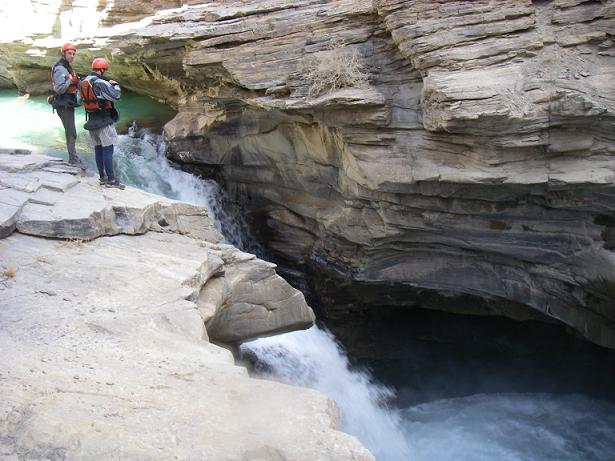
Downstream was the ‘waterfall canyon’ for which we had driven so far up the river. We took an earnest look at it with an eye to throwing down, but in the end put down only our egos and carried around. The problem was partly in the huge drop, but mostly in the outflow, where liberal portions of water exited via an overhung cave. We suspected a kayak would not exit as smoothly.
We camped at the mouth of a pretty side-canyon and made the first use of our newly acquired Russian stove, which burned gas, diesel, and jet fuel, but only with the greatest reluctance, and after lengthy prodding. The night was cold even with layers and the sleeping bags cinched closed, but the implications for the Muksu River, 5000 ft higher, really had us losing sleep.
The paddling was a modicum of great fun sprinkled among endless, sandy flats. The rapid of the day was a triple drop squeezed against the high, river-left wall. A manageable boof led into a deep, honking chute and a messy drop that bounced off the wall. Simon, going last, had a seemingly perfect entrance but flipped in the bottom chaos and slammed his head into a rock. He’s been acting strangely since, but we’re not sure there’s a connection.

In the morning we hiked up the side-canyon, partially to inspect its magnificence, but also to delay putting on wet clothes until the sun arrived. We were almost immediately stymied by an uninviting creek crossing. It was clear we couldn’t continue. As if on cue to show us what pansies we are, two Pamiris waded across the partially frozen stream, shoes off and pants rolled up to reveal red flesh . They were heading to a nearby town for a wedding; we used our boats to ferry them across the Shakhdara, so they wouldn’t have to walk up to the closest bridge, six miles upstream.
That evening we found another fine camping spot that was a little warmer with the lower elevation. The following day we finished the river, through miles of class IV, then III that led into the Gunt River. We took out in the middle of Khorog and made a spectacle of ourselves as we hiked the boats to our hotel through gaping, mid- afternoon, university traffic.
After a rest we departed Khorog for a second time, following the Pamir highway north, up the Gunt River. The road was smooth for a change, and our fully-laden Volga, kayaks in trunk, ate up the miles . The Gunt spills off the Pamiri plateau 100 miles upstream of Khorog, but most of the interesting whitewater is in the lower section of river. With this in mind, we put on 30 miles from Khorog, with food for two nights. The river, at the onset, was mellow. Meandering gravel bars were punctuated with short sections of sizeable waves and the odd hole. Like the Volga on asphalt, we flew through the miles. At 1 p.m. we caught sight of the Shakhdara valley not too far in the distance, and stopped, lest we reach Khorog too soon. We spent the afternoon relaxing amid house-sized boulders and crags in the warm sun. As evening approached, we were invited into a nearby house for chai, and vodka. Our host was a wiry, jovial man, and talented sitar player, even when hammered.

Fortunately, his inebriated driving was equally good, as he insisted on driving us the 300 feet back to our camp site. The next morning, we put on, anticipating the whitewater that the Gunt was saving up for us. Having covered three-quarters of the distance, but only half of the elevation, things were sure to get steeper. And steeper they got as the river dropped through continuous boulder rapids. At one point, though, the river constricted to 15 feet across, and the water pummeled into a badly undercut right wall before dropping over a nasty hole. After a bit of debating we portaged. As we neared Khorog, a nice section was unfortunately slightly dewatered by a dam. This might have been fortunate for Simon though, who found himself enjoying some more quality time in a sticky hole. We reached Khorog mid-day, and walked up the hill through town again to the Pamir Lodge. There we enjoyed our last respite before plunging into the looming Muksu endeavor.
At last we were heading to the Muksu, the river that lay monumentally before us, darkening any thoughts of a sunshiny future, making long-term plans seem speculative and premature. It was known as the “hardest river of the USSR.” But in the end, the challenge of the Muksu lay almost entirely in getting there.
The first leg of the journey was a fifteen hour drive from Khorog. We found a sturdy-looking Russian vehicle piloted by two friendly Pamiris and paid them half of our agreed- upon price before embarking. We drove all day and spent the night in a house 30 miles short of our destination. In the morning, our drivers refused to continue, citing the poor mountain roads and low fuel. We considered these complaints tardy for the negotiation process and withheld the remaining payment until we could find a ride. This went over poorly. All morning we argued with them and rehashed the pieces of our broken agreement. Eventually, they tried to take our boats. Andrew grabbed the one they were taking, and the odium of the co-pilot truly blossomed. While Andrew struggled to match Russian adjectives and nouns for case, gender, and number, the co-pilot grabbed him by the collar and started punching him in the mouth. Meanwhile, twenty Pamiri townsmen had gathered around, and it was our best guess that their sympathies lay elsewhere. Simon simultaneously restrained himself and the co-pilot, and we quickly reached an agreement to pay them some of the money.
After they left the townspeople asked us why we had ever hired such crazy drivers and found us another ride, albeit an exorbitantly priced one. Before leaving, an opportunistic national park representative found us and charged us $100 to cross park land. In these cases, what can you do? Feel outraged but move on. We got an UAZ ride to the dismal Kok Jar, alleged by our map to be a “forest of outstanding beauty” but more aptly just a forest that’s still standing. The early stop added six miles and 1,300 vertical feet to our hike, but to distance ourselves from the last twenty four hours, we were happy to take it.

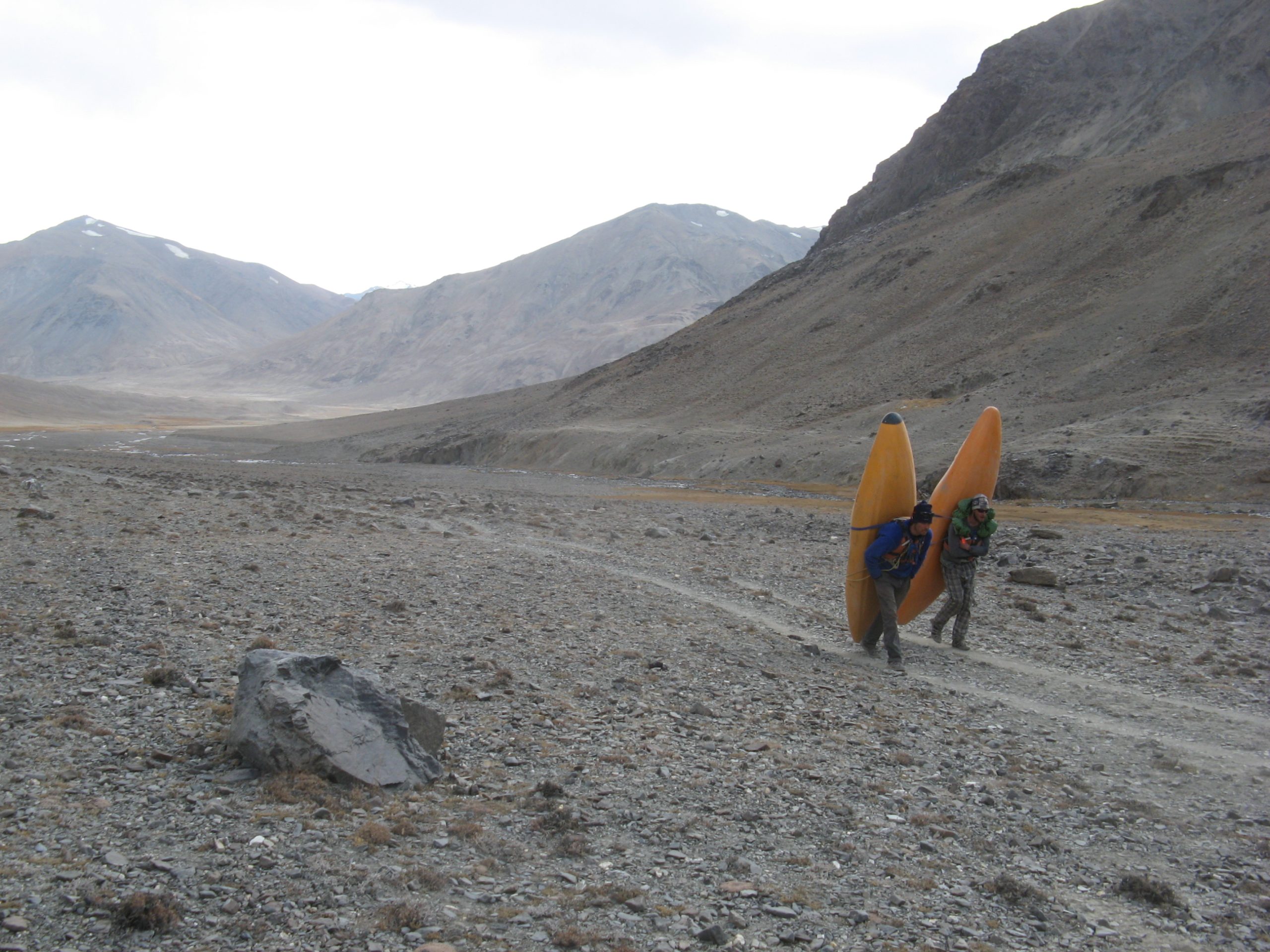
Our new, nicer driver dropped us off at the bottom of a pass in gale force winds and late afternoon sun. He eagerly pointed out the best footpath; the road was long, he said. He wished us safe travels with a gift of bread. We harnessed the boats to our backs as we always had in Tajikistan. Maybe it was the added weight of two weeks of food, maybe it was the screaming wind, but we all staggered the first steps. Ahead loomed two passes taking us up to 14,800 feet and at least 20 miles as the crow flies to the (possibly frozen) Belandkyk River.

We were purposefully late in the year in order to avoid extreme summer floods. We were late even compared to other Russian paddling expeditions. The winter cold, and a potentially dewatered tributary that would take us off our feet and into the Muksu, the Belandkyk, seemed like a small price to pay for the assurance of lower water on the Muksu. Thinking about all this only made the boats heavier as we sucked wind up the pass. We hunkered down for the night in a flat spot most of the way up the pass and tried not to speculate about the future.

The morning began with high altitude headaches and frozen water bottles. The headaches abated with time; carrying a load of half our body weight warmed us up. A slight redefinition of terms is necessary at this point. Carrying was not a continuous motion but rather a repeating cycle of 20-50 feet of walking then a 30 second break to parse oxygen from the thin air.

By mid-day, we reached the valley leading to the Takhtakorum Pass. The ground was fine dust, scattered with cow and sheep dung. We dropped our boats and dragged them behind us to give our shoulders a break. By evening, we were at 13,200 feet, and our Russian stove required a cleaning to start.
The next day saw more trudging. If you didn’t fully catch your breath during a short rest, you would lose it after your first two steps and have to stop again. We hiked in jackets, hats, and two layers of warm clothes. Andrew spotted four Marco Polo sheep wearing nothing but fur.

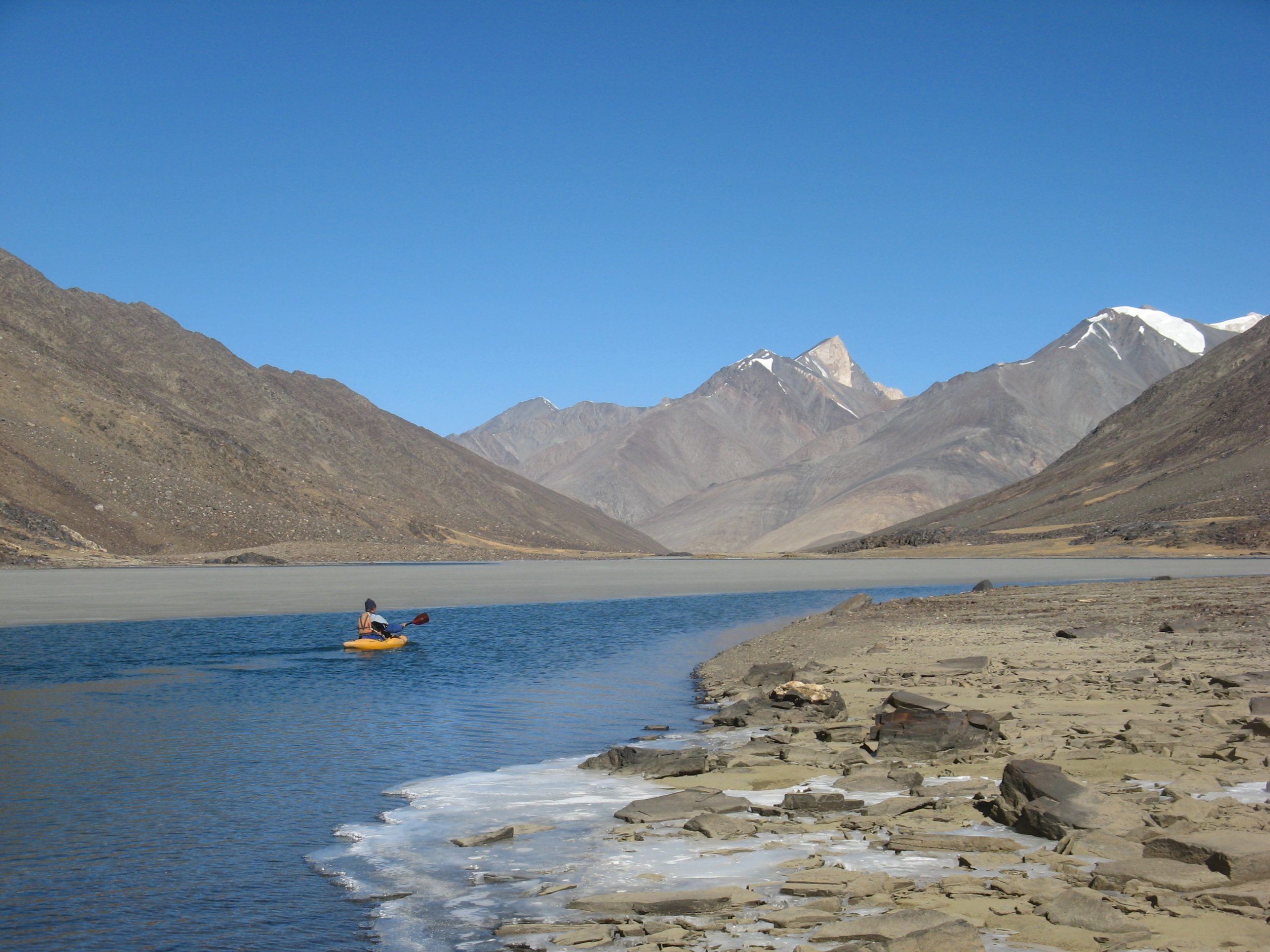
The next morning we reached the pass and looked into the watershed that had occupied so much of our thoughts for the past months. Wind had blown the ice on a small lake at the top slightly to one side and, exhausted and sore from carrying, we paddled a half mile in the exposed water, carefully avoiding splashes.

We crossed the lake and hiked into the watershed. The descent was tough but short. We climbed over large, sharp, black slate rocks. Days earlier it had become too cold to rest for long and enjoy our breaks; we just wanted to schlep on and start paddling.
Finally, the Belandkyk. Thick ice covered the edges and the rocks, but water flowed in the middle. Not enough to paddle, but it looked promising for the next day once tributaries added water. After lining our boats, we settled into the four walls that remained of a shepherd’s hut, and discovered a valuable trick we would use for the remainder of our Tajik travels: sleeping squished together provides warmth.

The valley was spectacular and seemed to end directly in mountain tops. We saw a herd of ibex and were becoming convinced a sasquatch-size marmot was pilfering our food at night. Our stove required multiple cleanings to work every time. The moon was almost full.
The next day was a tough one, as the Belandkyk disappeared all together-either from freezing or going underground. We wondered how long we would walk. That night, our edifices slowly deteriorating, we slept between two walls of loosely stacked rocks against a cliff. A beautiful snow added an unnecessary shockwave to our morning headaches. Our hands had a dry black sheen from dirt and crisp air that we had previously seen on shepherds. The snow coated the land and our troubles with an attractive layer.

Cresting a rolling hill, we saw people at a large cabin. Our minds sifted through possibilities of what on God’s green Earth people would be doing high up in the mountains that time of year besides the obvious, like watersports.
Their greetings were friendly, and as we approached we noticed western items and a guy talking on a satellite phone. They welcomed us warmly with tea and food, and revealed they were a Norwegian and Italian hunting camp. A helicopter would come for these clients a couple days later, and replace them with new people, all of whom were there to hunt endangered species.
At one point conversation became heated by politics, which could not have been more surreal amongst snowy 20,000 foot peaks. They invited us for the night, but when we opted to catch the afternoon glacial melt and begin paddling, they advised us about a cabin downstream.
With three and half hours of daylight to cover the distance to the hunting cabin, we hastily packed our boats and geared up amidst the on-looking Tajik guides and staff. We thanked them for their hospitality, bid them farewell, and commenced the “paddling” leg of our journey. The first few miles involved more pushing off rocks and ice than actual strokes, but we were relieved to be unyoked from the burden of carrying. The air was cold, and almost immediately a veneer of ice coated our life-jackets, dry-tops, and pogies. We paddled hard to stay warm, and to secure a night of warmth in the cabin, whose stove and well-stocked woodpile awaited. As dusk approached, we got out occasionally to scan the valley for the hospice, but to no avail. Even with a push well into twilight, the cabin failed to materialize. Defeated, we snapped icicles from our helmets, frost from our beards (some expedition members more than others), and braced ourselves for a cold night under the tarp. On the upside, in our rapid decent we had crossed the snowline, and saw small shrubs for the first time since the far side of the Takhtakorum pass. On the downside, Jack Frost was not to be outdone so easily, and we passed the night slowly as snowflakes stealthily settled around us.
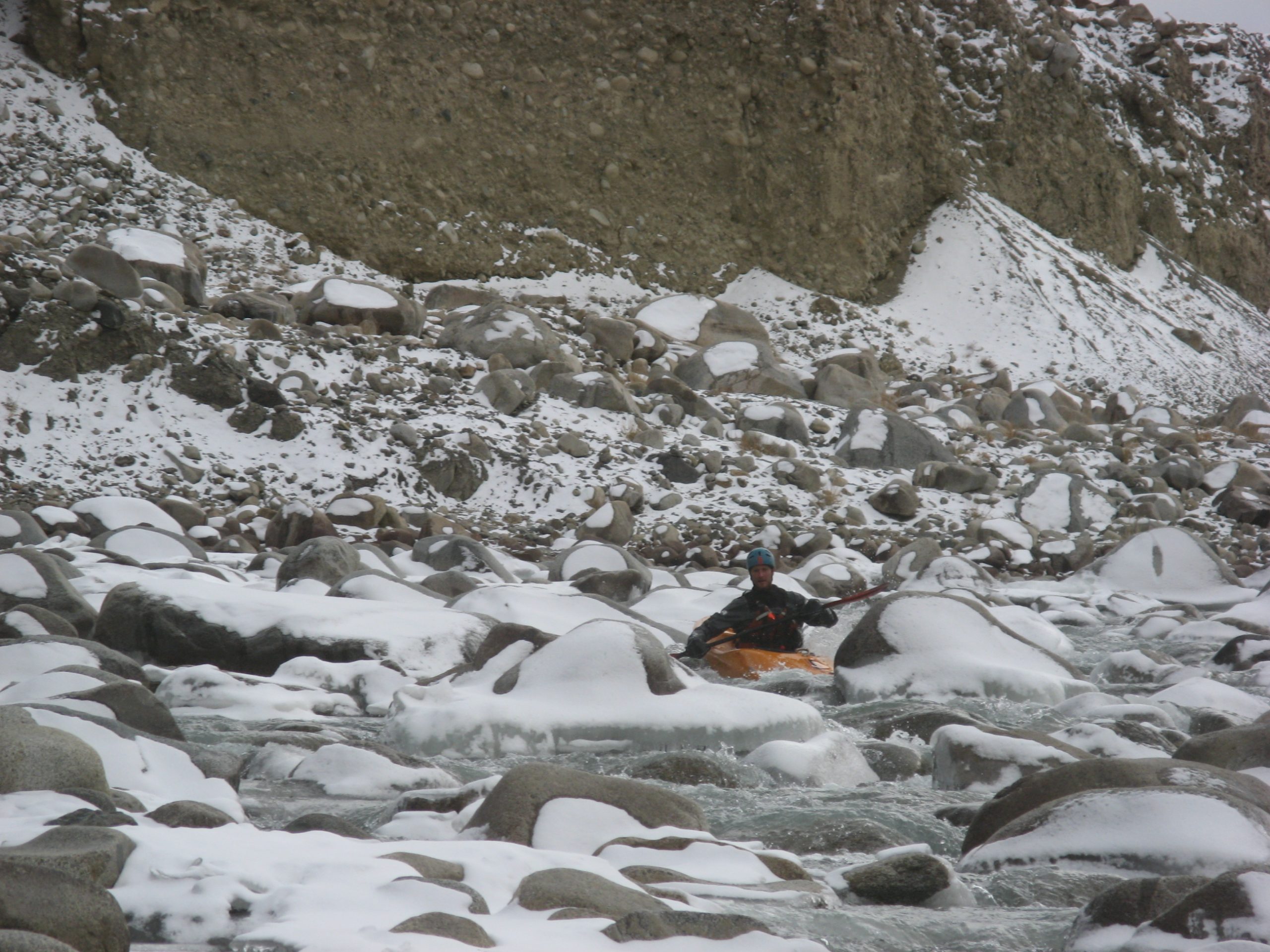
We started late the next morning to allow the river to rise, and to thaw our frozen gear. The paddling picked up where it left off; rocky boat abuse and cold hands. We reached a short canyon section of the Belandkyk mid-morning, where an iced-over narrow drop forced us to portage up a snowy embankment and seal launch back in below before resuming the frustrating downriver battle. For a second time, we crossed the snowline, and were heartened by the return of full-sized vegetation. That night we celebrated the advent of fire like Neolithic cavemen, while simultaneously lamenting the new-found split in Andrew’s boat. That nocturnal asshole Jack Frost paid us another visit, and we awoke to more snow and frozen gear.
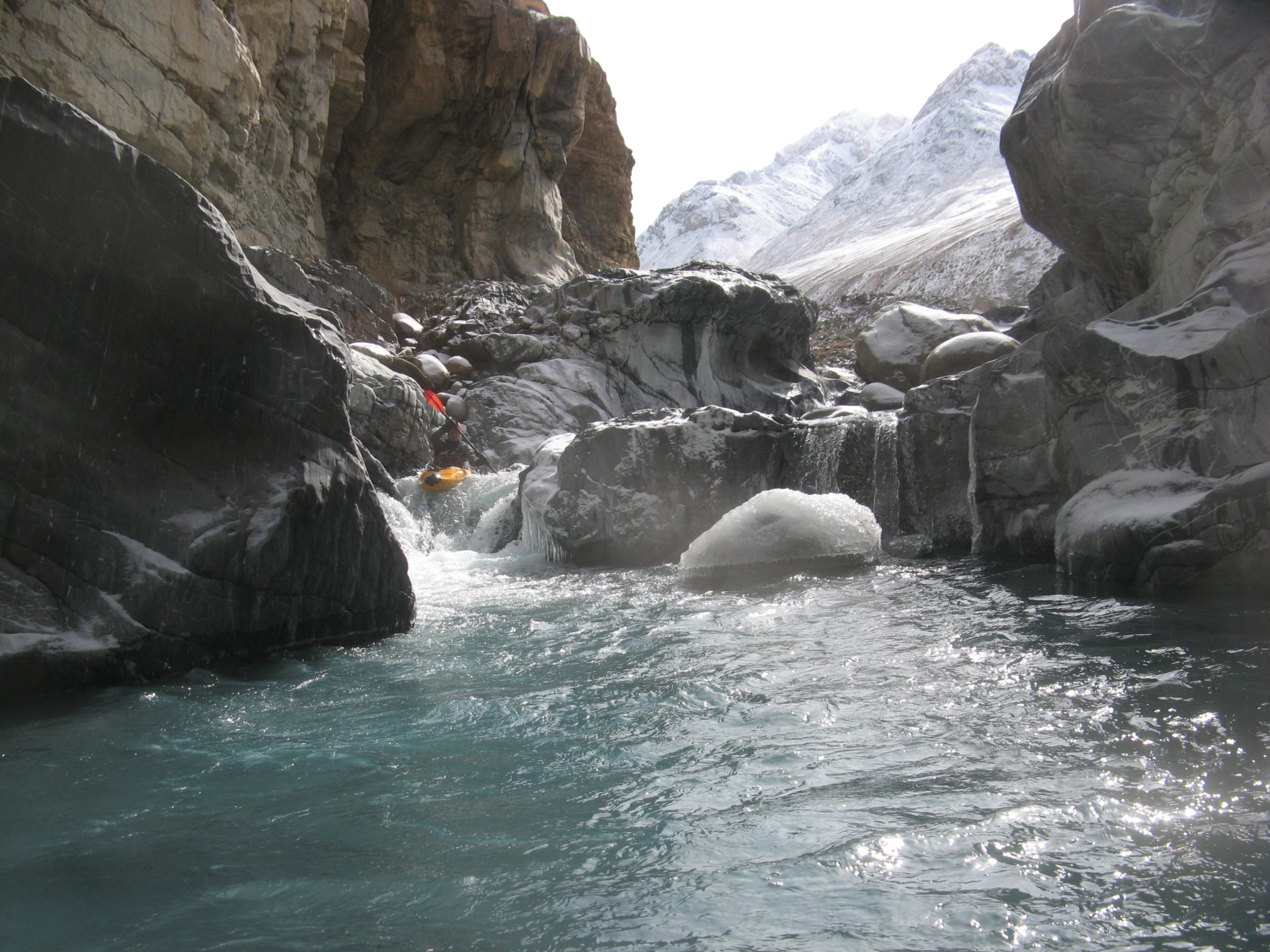
We reached the foot of the massive Fedchenko glacier, one of the longest in the world, and the flow more than doubled to about 1,000 cfs. The next section of river, a pre-curser to the Muksu, wandered from side to side of the wide, U-shaped valley. 20,000 foot peaks loomed in the distance. An upstream wind kept things chilly, especially for Andrew, who’s boat routinely took on submarine properties after parting with its patch at every opportunity. We found a sheltered campsite in the afternoon, indulged in another fire, and speculated about the infamous canyons of the Muksu for one last night.
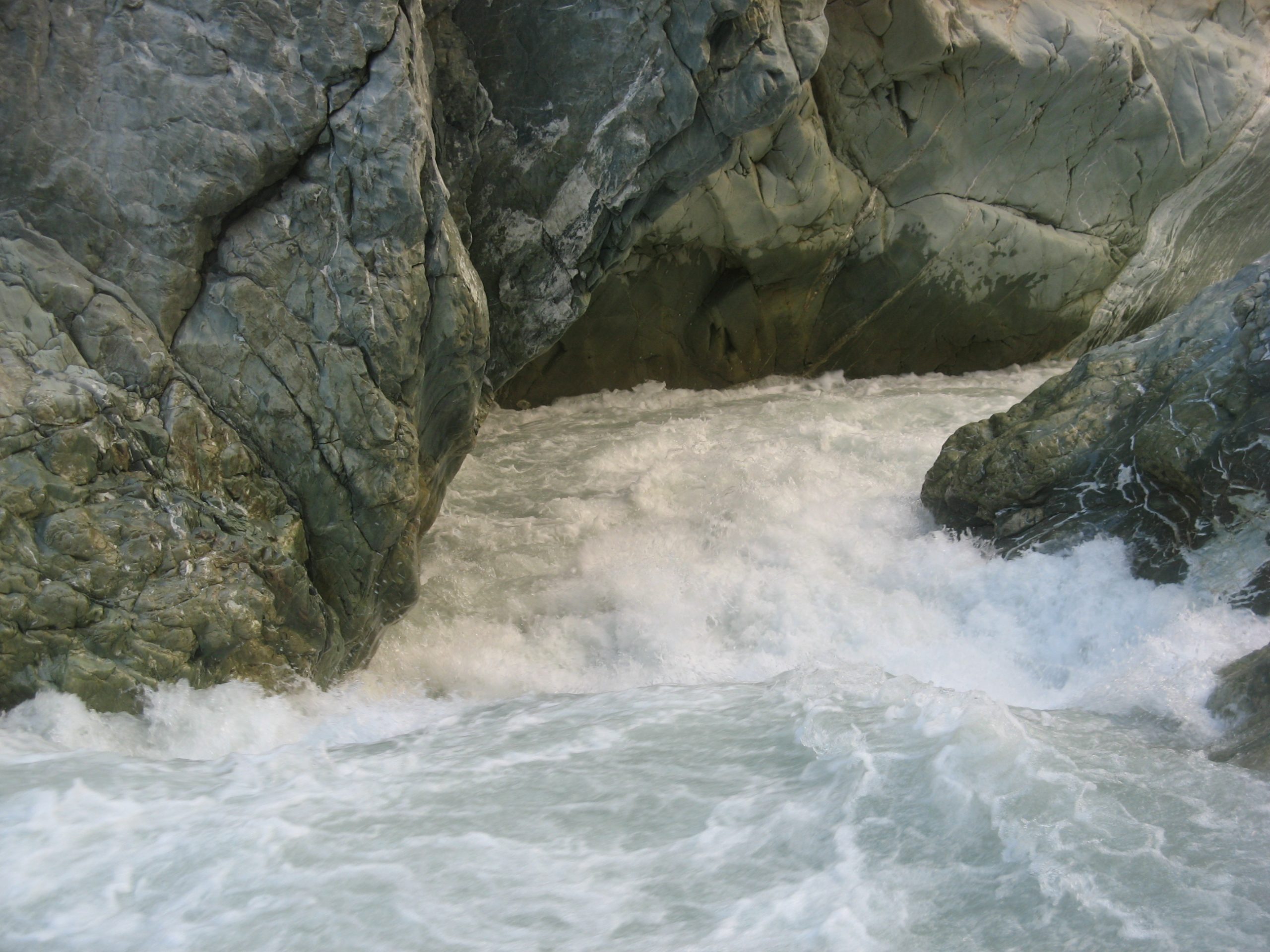
Late the next morning, we scouted the first of such canyons; we watched from a 300 foot cliffside perch as the river disappear around a blind corner. Middy returned from scouting, stymied by a scree slope even an ibex would balk at. With no other options, we looked at each other, shrugged, and got back in our boats. A stalwart rapid with two beastly holes in quick succession guarded the canyon entrance. Fortunately, we all caught the must-make eddy on the lip of the first hole and portaged without incident. During the portage, we saw footprints in the sand. The most likely belonged to a Russian group rumored to have been there two weeks prior. The signs of voyageurs on the same route gave us a bit of comfort, but detracted slightly from the sense of remoteness. We rounded the bend, finding only more beautiful canyon, and runnable rapids below.
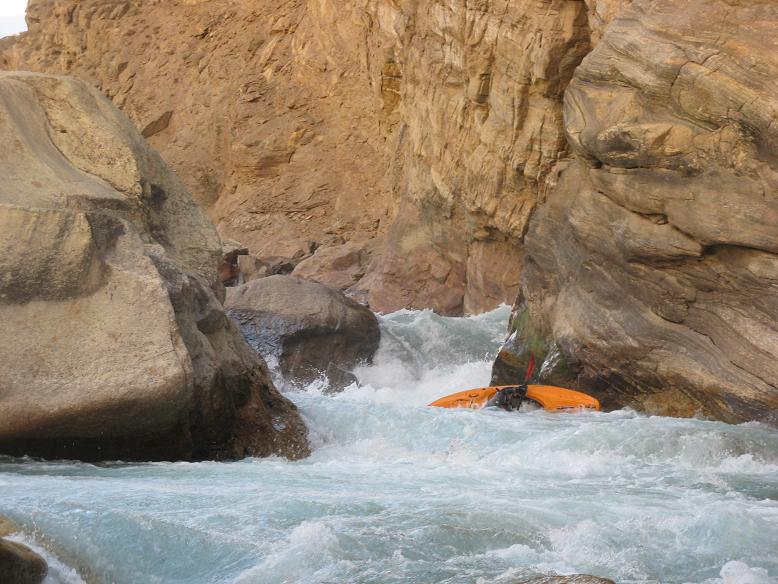
Our deliberately late season run on the Muksu seemed to work all too well, and we found little of the ferocity that had lurked in the back of our minds for months. The rapids were largely fun, though committing, and it is easy to envisage the maelstrom that would accompany higher water. As it was, we boat scouted most rapids, except when Andrew had to empty, in which case he’d give directions to Middy and Simon, e.g. “If you back-paddle at the lip of that drop…no, no, closer…closer…closer….yeah, you can see a big rock below the ledge. Drop off side-ways in front of it.”

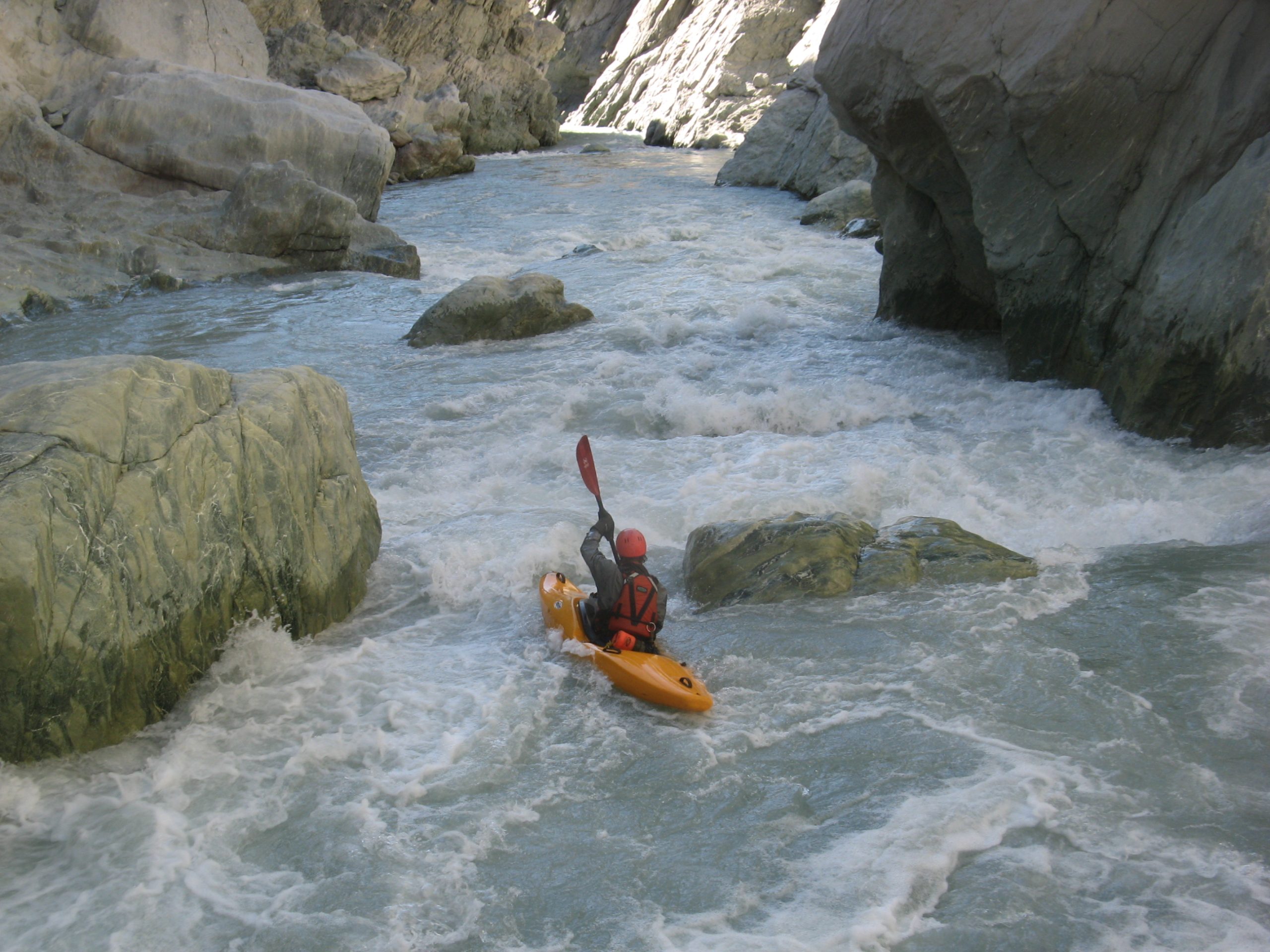
Since we were behind schedule getting to the canyon section of the Muksu, we had cut back our food rations to allow a couple of extra days. Sooner than we expected though, the canyon walls opened up. After only a day and half we passed the first signs of civilization, Tajiks panning for gold. After a marathon, blister-inducing day, we reached the Surkhob River and paddled in to Djirgatal, where a month prior we had explored the south flowing rivers. We feasted on our remaining sausage before heading into town. We met our old friend Ismonoli, who let us back into our home away from home, the Djirgatal Regional Airport. There, we rested a day before driving to our final river, a late season classic, the Obikhingou
Andrew, Simon and Middy
Stay tuned for final thoughts from the team about their Tajik travels in our next issue. SZ.
Leave a Reply