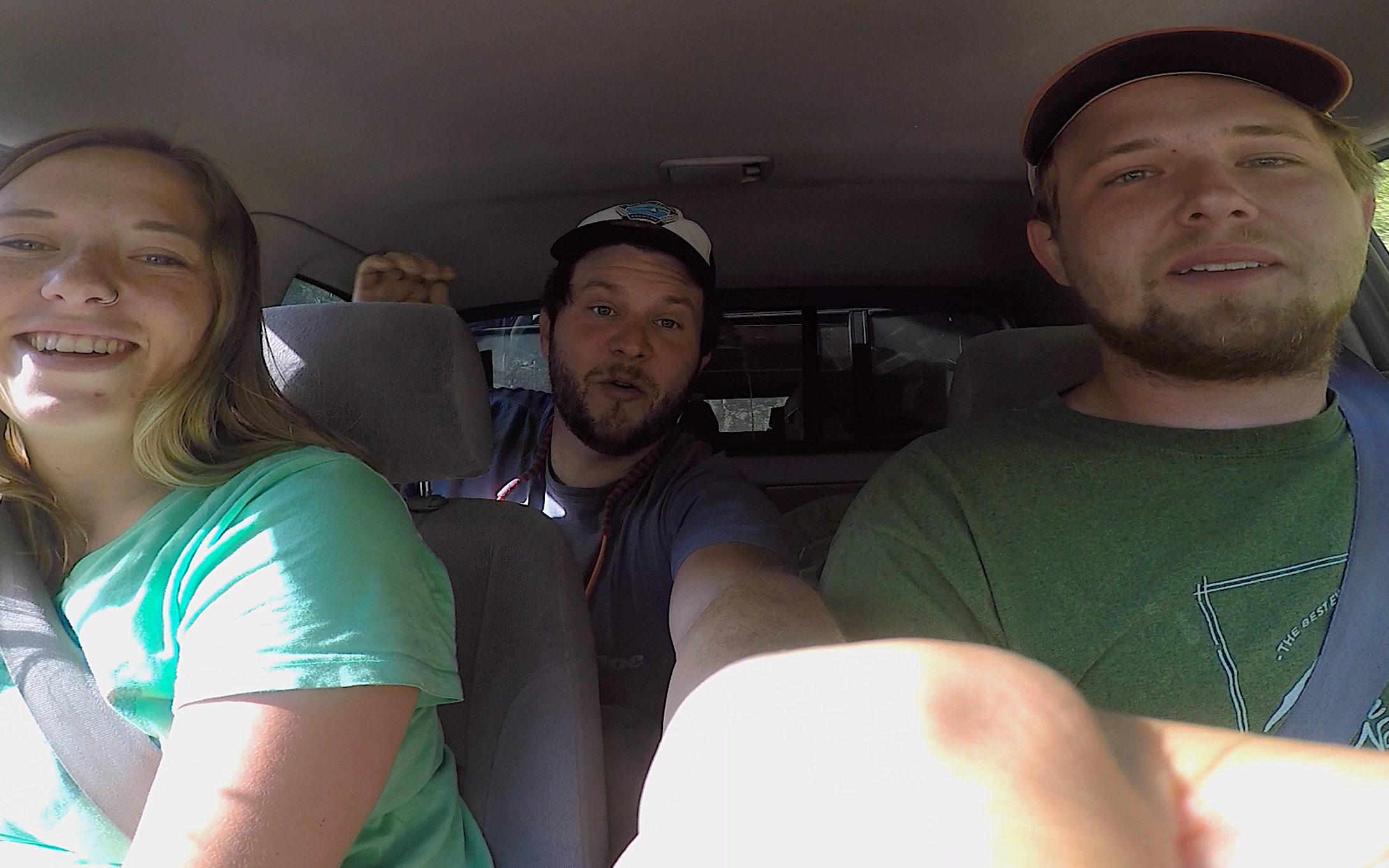
Sometimes the shuttle is the adventure (click for video).
Cabot and I sat on the boat ramp, watching the aquamarine tendrils of the Salmon River swirling at our feet. As we drank our last two Rainiers, I checked my phone. Still no signal and the hour was growing late. It had started as a joke, two days earlier. Three hours ago it was still a smirk and a wink. Now it was no longer funny, and our panic was palpable. We were deep in the Idaho wilderness, and neither Cabot’s truck nor the shuttle driver we’d found on Tinder were anywhere to be found.
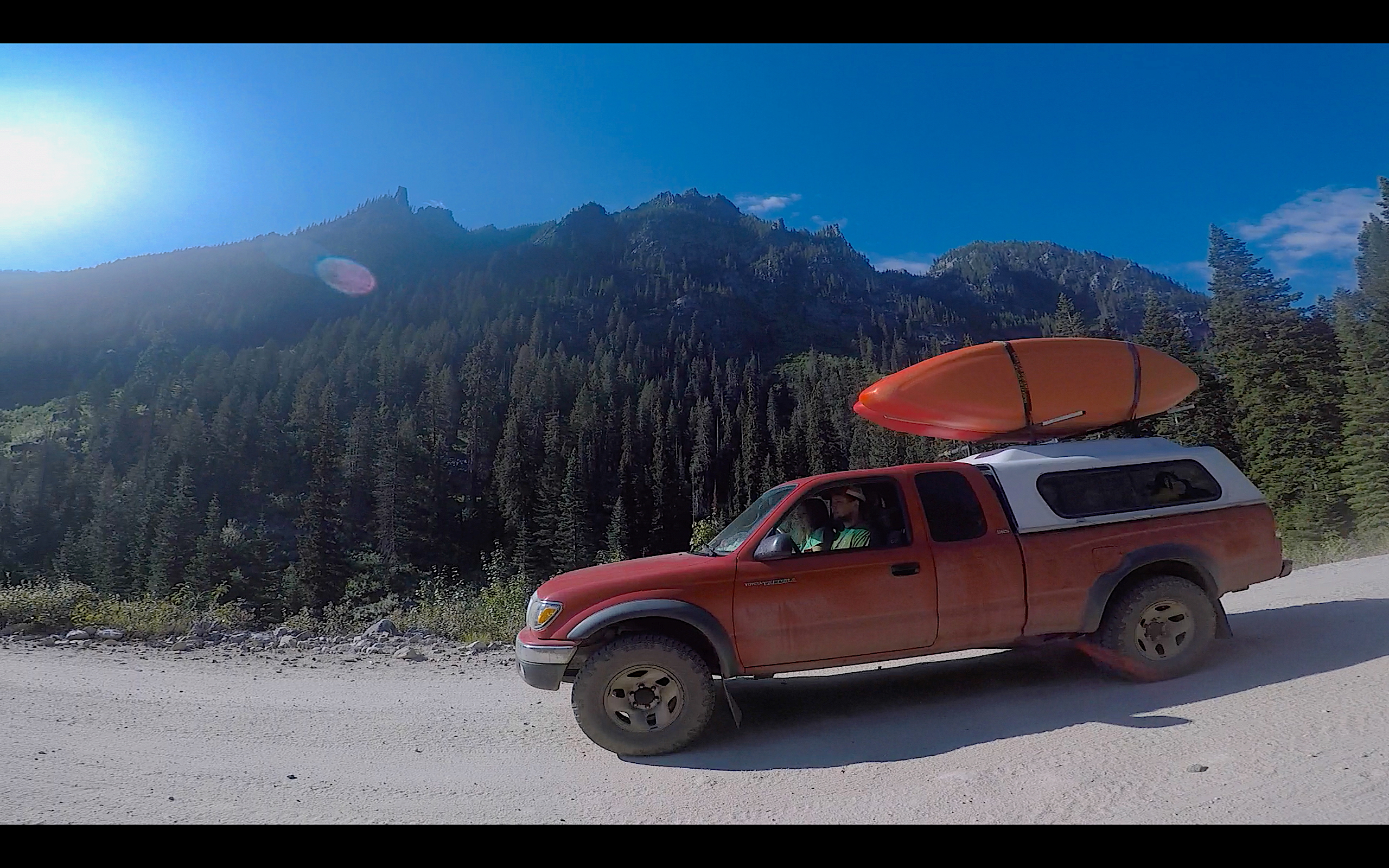
Photo Chris Loomis
Our predicament is a story of friendship, bad decisions, and the nature of exploration. Why do we seek adventure, and what can we learn from the misadventure that often accompanies it?
—-
“Adventure is just bad planning.” – Roald Amundsen
Amundsen’s famous quote is often extolled as a warning. With all due respect to the explorer, I don’t see it that way. I live for the unexpected gray area between Type II and Type III fun, and seeking the live wire of life on challenging whitewater had become the singular focus of my existence in the summer of 2018.
The Idaho pit stop was a testament to my poor planning and poorer mechanical abilities. A summer road trip evolved after my truck broke down. I couch surfed in Boise while I waited for repairs. Unexpectedly dropped in the mecca of whitewater, I needed a friend with a working vehicle who wanted to shred. Enter Cabot.
Cabot, a senior engineering student from Tennessee, was also on a summer paddling roadtrip. A week earlier, I conned him into stopping in Boise for a few days to paddle the Payette. A few days morphed into ten, and after knocking off some of the Idaho staples, there was one run left on our list, the South Fork of the Salmon.
The South Fork is a multi-day classic featuring 50 miles of big whitewater in the heart of the Frank Church Wilderness. Our problem was the eight hour shuttle. We needed a driver to make our dream a reality. The only company that offered a South Fork shuttle charged over $400 for their trouble, much more than our meager budget allowed. But relentless optimism reared its head, and we decided to send it.
We left Boise with a loose plan: drive to McCall, find a driver, paddle. I navigated Cabot’s truck onto Highway 55 as Cabot doom-scrolled. Out of the corner of my eye, I saw him perk up. His East Tennessee drawl matched the efficiency of his Tacoma’s underpowered motor as we chugged up the hill.
“I just matched with a girl on Tinder.” Cabot said.
“So?”
“She says she lives in McCall.”
“Ask her if she wants to run our shuttle!”
A few minutes later, his phone vibrated. Cabot laughed.
“She says she’ll do it for a hundred bucks.”
Instinctively, I slammed the gas pedal to the floor. The engine screamed, the transmission shuddered, but the truck didn’t accelerate. We crept into the mountains.
—-
Adding to the trophy of red flags we blew past was the fact that we knew almost nothing about the river. Our only map was a road atlas, we didn’t have a guidebook, and the few trip reports we could find were discouraging tales of high-water epics and must-run Class V monster rapids in a remote wilderness far from civilized society.
There was another issue, a self-inflicted bout of ego and hubris that lingered in the back of our minds. The crafts we brought for the potential epic were not big water optimized kayaks, or even rafts, but open whitewater canoes. Cabot and I both repped for canoe companies, and as our skills increased and our paddling horizons broadened, the limitations of the vessel became more pronounced. On the low-volume southeastern creeks near our homes, the open canoe had its place, and we could even delude ourselves into naming a few advantages. But in Idaho, where the whitewater was big and pushy, the rapids long and cold, an open canoe was not the weapon of choice.
But we were comfortable in canoes and the South Fork was on the low side. We were both young, footloose and fancy-free, and as we pulled into Lardo’s Saloon for our first date with our potential driver, I ignored any misgivings in pursuit of my favorite feeling: running new, challenging whitewater in a beautiful place with a good friend.
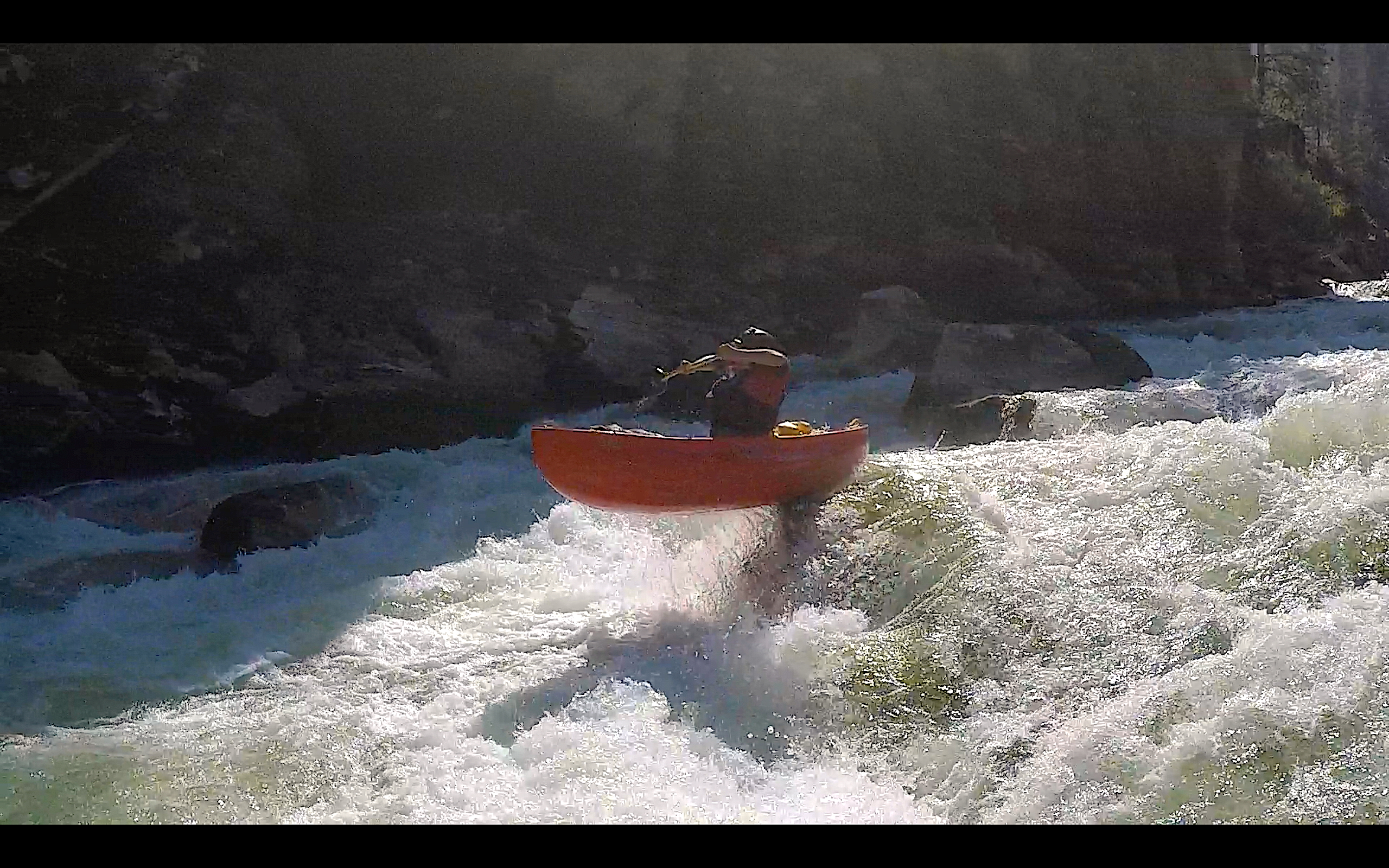
Chris boofing OC1 style. Photo by Cabot.
Her name was Kendra, and it was love at first sight. She was young, vivacious, available tomorrow, and could drive a stick shift. She had even run a South Fork shuttle before. She was perfect. We made plans to meet in the morning. That night, as we laid on our Paco pads under a blanket of stars, I leaned over to Cabot.
“You know, I think everything is going to work out.” I said before I fell asleep.
It would be fair to ask why I was so optimistic, and why either of us thought it was a good idea to give Kendra the truck keys. The answer was simple: our desire to run the South Fork outweighed our concerns that Kendra was running a Tinder shuttle chop shop. We wanted to go paddling, and instead of focusing on potential disasters, we thanked our good fortune for a unique opportunity. I dreamed that night of rapids and rainbow trout, and pushed any lingering worries deep into the recesses of my mind.
We packed lean. We carried one extra paddle and two extra meals. We didn’t have an InReach. If something happened, we’d be on our own. Everything I brought fit in two small dry bags. Cabot, less worried about weight or perhaps more realistic about our caloric deficits, brought his fly rod. After two hours of dirt-choked back roads, we stood at the put-in.
Kendra doled out hugs and best wishes. Eager to begin, I shoved off into the current with Cabot close behind. By the first bend wilderness enveloped us. The dirt road was out of sight, and the next road was three days downstream. We floated together, holding each other’s gunwales, drifting past the point of no return. I was taking in the scenery, but Cabot’s face belied concern more than awe.
“You know… we never actually saw her drive away. Do you think she knows how to start a manual?”
His words hovered over us as we floated the flatwater, and they were still there when we reached the first rapid.
—-
The trip was everything we hoped for. The river was low but navigable in our wildly unsuitable crafts. Bracketed by ponderosa pines and spires of lichen-choked granite, each rapid was a new puzzle, each bend in the river a new vista. Evenings provided spectacular fishing, and we supplemented our meager rations with rainbow trout. We saw a single Chinook salmon, battle-worn from its 2,000 mile journey, as it glided toward its spawning bed, an ancient reminder of what this river must have looked like a century before.
In between the incredible beauty and adventure, I pulled at the thread of doubt that festered in both of our minds.
“You know your truck is probably getting parted out in Nampa right now.” I said one afternoon, as we watched bighorn sheep climbing a cliff band.
Cabot laughed. What else could he do?
On the last night, we camped just above the confluence of the South Fork and the Main Salmon. The smokey summertime dusk was losing its fight against the encroaching inky blackness, and as I stared up at the stars, I felt a whisper of wind on my face. Then another. I bolted upright. A squadron of screech owls, perhaps 30 of them, darted silently between the trees. The aerobatics were too lively, too coordinated to be hunting. The owls put on an airshow just for us.
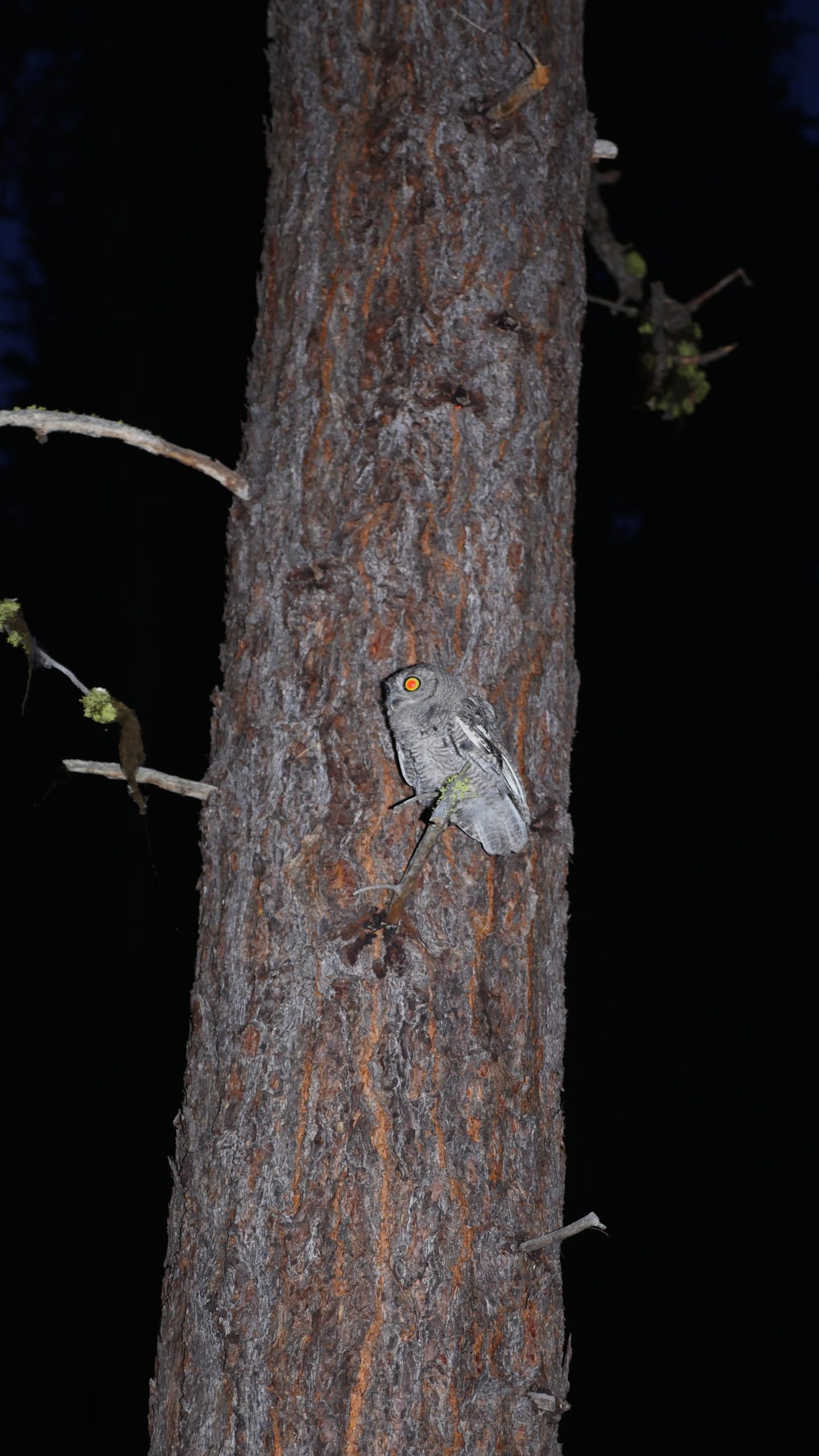
Photo Chris Loomis
The next morning, as I loaded my canoe, Cabot chuckled.
“What are the chances my truck is at the takeout?” He asked.
“Ten percent, maybe.” I laughed.
We’d told Kendra to meet us at the takeout at noon. Our arrival was hastened dramatically when we caught a ride on a jet boat, expediting the final twenty mile slog. At 10:45 AM, we stepped onto the boat ramp. I set my wet gear out to dry, found a comfortable rock, and waited.
Noon came slowly, but Kendra did not come with it. At 12:30 we walked through the parking lot, to see if perhaps she had already left the truck. Herds of Tacomas grazed in the gravel, their hoods raised in an attempt to ward off marmots. But none were Cabot’s.
Cabot fired up his JetBoil and we cooked our emergency dinners. Not long thereafter, I begged for the use of a sat phone from a commercial guide, and called Kendra. The connection beamed to outer space and back, only to land in Kendra’s voicemail.
By 2:00 neither of us were joking. Hell, we were barely speaking. My brain was beginning to process the next steps, and we laid out a plan. If Kendra didn’t show in the next two hours, we would ditch the boats and hitch to Riggins. From there we’d have cell service and an outside chance of finding a ride to McCall before dark. We loaded our essentials into our Watersheds and walked back to the boat ramp, partly to try and make nice with the next shuttle vehicle we saw, and partly because we didn’t have any other move to make.
Doubt crept in. What did we really know about Kendra? Maybe she had stolen the truck, or maybe some horrible accident had befallen her. Stuck in the woods without any communication, our minds spiraled into worst case scenarios.
As an expedition paddler, the skill that I bring to the team is not my amazing ability in whitewater, or my overwhelming strength in rescues. My best attribute is my relentless optimism. “Everything will work out, and it’s all going to be fine.” That’s my mantra, and it has pulled me through some gnarly situations. But as the sun plunged to the horizon, I could feel my superpower hitting its kryptonite: reality. Best intentions and unbridled optimism were giving way to the new world order. We weren’t in any imminent danger; we had our health and our credit cards. We were going to work it out. But as afternoon became evening, the next phase of our lives was going to have a suck-factor that could have been avoided.
—-
Cabot saw it first, his red Tacoma bumping down the dirt road, contrails of dust billowing behind. Our Tinder shuttle had arrived.
“I’m sorry I’m late!” Kendra bellowed out the window. “I missed a turn!”
There are two turns on the shuttle. Two. I was suspicious, but not about to question our salvation. We loaded the boats and turned our attention to our sobriety. I rummaged through the detritus in the back of Cabot’s truck until I found the cooler. As I cracked the lid, the rank odor of four-day old rotten fish overwhelmed me. In our haste to depart, we’d forgotten to dispose of some trout, and now the wanton waste assaulted me. Between gags, I grabbed six beers and ran to the river to wash off the putridity.
We worked like surgeons, delicately prying the truth from Kendra, who graciously drove while we slammed warm Rainiers. She hadn’t missed a turn, she had just overslept. The reason? She had gone on a Tinder date the night before that had gone exceedingly well and had carried into morning.
Back in McCall, we went out to celebrate our success. Somewhere between our eleventh and twelfth tequila shot, Cabot and I were abruptly and politely ejected from The Yacht Club. Apparently the rest of Idaho was not impressed at our South Fork survival. In the ensuing confusion, we lost Kendra. Perhaps she reunited with her date from the previous night, or perhaps she had finally reached her limit of dealing with two drunk, infantile morons. Regardless, we were now lost in McCall and separated from Cabot’s truck once again.
Like Amundsen himself, I utilized celestial navigation and dead reckoning as we wandered through residential neighborhoods. Blind optimism, and careless drunkenness, finally led us back to Kendra’s house. The door was locked but we broke in through an open window, demolished a Costco-sized tub of animal crackers, and passed out in the living room. Two hours later we left, the crumbs of enriched wheat on the floor the only evidence of our stay.
—-
Nearly a decade later, the Tinder Shuttle Story is a crowd favorite, the crown jewel of an incredible two weeks in Idaho where our adventures on and off the water made us better paddlers and better friends.
With age allegedly comes wisdom, and there are aspects of the story that I find embarrassing. I look back at some of our decisions as loose at best, reckless at worst. We ignored plenty of warnings. Try as I might, it’s hard to go back to the mindset of my mid 20s, when I was constantly broke and only cared about my next paddling trip, a mindset that allowed us to believe it was a responsible decision to give our keys to a stranger we had just met on a dating app. At the time, our lack of InReach did not deter us. I’d definitely bring one today.
But caution is the cancer of experience. The most important lessons I’ve learned, both as a paddler and as a person, have usually involved me falling on my face. Learning to get back up, to keep moving, to be relentlessly optimistic that everything will work out in the end, has been worth the bruises I’ve picked up along the way. If I put on the South Fork tomorrow, I would make more prudent choices. But those choices are directly influenced by knowledge I gained only because of the dumbass-edness of my youth. Some of life’s most important lessons can only be learned experientially.
I’m glad we put on the South Fork. I’m glad we lived. I’m glad that Kendra finally made it to the takeout. I wouldn’t change a damn thing.
Author’s note: Years later, I reconnected with Kendra – I was happy to learn that she became a river guide. A yoga retreat on the Main Salmon propelled her into a summer working on that river. I was blown away by the confidence and self-assuredness she had gained. As of this writing, Kendra denies that Cabot or I played any role in it.


Leave a Reply